Compliance
Do Colorado Schools Need Panic Buttons? Alyssa's Law in Colorado, Utah, Wyoming and New Mexico
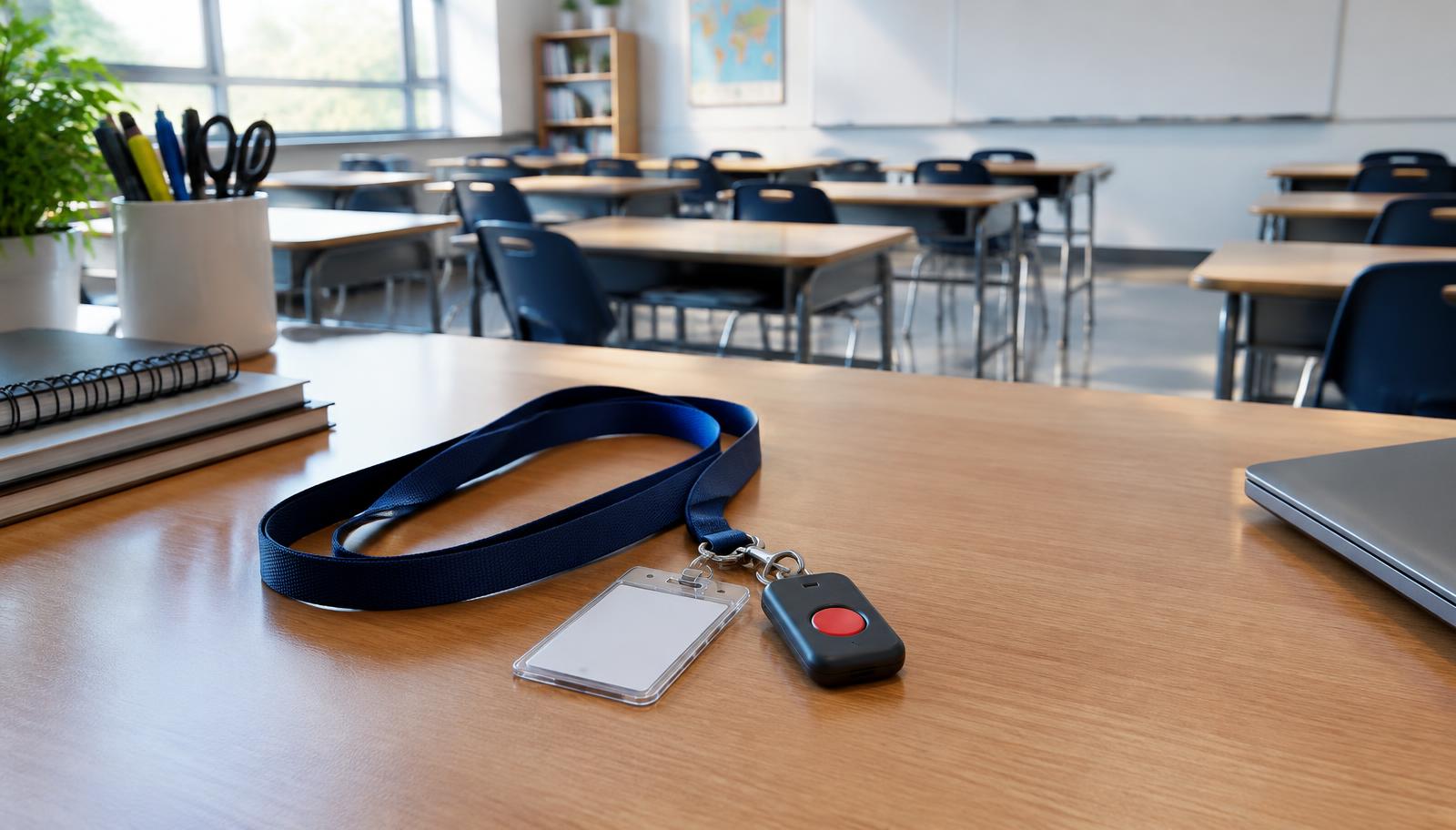
No. Colorado does not require panic buttons in schools, and neither do Wyoming or New Mexico. Utah does. Under Utah's version of Alyssa's Law, the lead teacher in every classroom must carry a wearable panic alert that reaches 911 dispatch directly.
That is the short answer for our four-state region as of October 2026. The longer answer matters more, because "not required" is not the same as "not expected." Parents, boards and insurers increasingly assume a teacher can call for help silently, from anywhere in the building, in one press.
What Alyssa's Law is
Alyssa's Law is named for Alyssa Alhadeff, a 14-year-old killed in the 2018 shooting at Marjory Stoneman Douglas High School in Parkland, Florida. Her family has pushed state by state for silent panic alarms that connect schools directly to law enforcement, so responders are dispatched in seconds instead of after a chain of phone calls.
There is no single Alyssa's Law. Each state writes its own, and they differ in what they require, who must comply and how it is funded. A federal version has been introduced in Congress but has not passed.
Which states have it
Thirteen states had enacted a version as of September 2026, ten of them since 2023:
- 2019: New Jersey
- 2020: Florida
- 2022: New York
- 2023: Texas and Tennessee
- 2024: Utah and Oklahoma
- 2025: Georgia, Washington and Oregon
- 2026: Virginia, West Virginia and Illinois
The strength of these laws varies a lot. Texas requires silent panic alert technology in every classroom. Utah requires wearable devices for teaching staff. Virginia's 2026 law permits school boards to issue wearable panic alarms but does not require them. Read your own state's statute, not a vendor's summary of all of them.
State by state in our service area
Colorado
No Alyssa's Law, and no statewide panic alarm mandate. Two related Colorado laws still shape the decision. The Claire Davis School Safety Act lets families sue when a school fails to use reasonable care to prevent foreseeable violence, which makes documented safety planning matter. And SB26-104, signed in May 2026, requires schools to install an exterior key box for law enforcement emergency access by July 1, 2030. A panic alert that summons police pairs naturally with a key box that lets them in. See our Colorado school security requirements page for the full picture.
Utah
Utah passed Alyssa's Law in March 2024 inside HB 84, its large school safety bill, and amended it in 2025. Today it requires local education agencies to:
- Give the lead teacher in each classroom a wearable panic alert device that communicates directly with public safety answering points, the 911 dispatch centers.
- Train all school building staff on the device protocol before each school year.
- Make the school's security cameras accessible to local law enforcement.
- Complete a school safety needs assessment.
The camera access piece is the one districts underestimate. A panic alert tells police something is wrong. Camera access tells them where and what. Both should be designed together. Utah's School Safety and Support Grant can fund panic devices, so check the current cycle before you budget from the general fund.
Wyoming
No Alyssa's Law as of October 2026. Districts decide for themselves.
New Mexico
No Alyssa's Law as of October 2026. Districts decide for themselves.
If it is not required, should you do it anyway?
Usually yes, but buy it for the right reason. A report from one major panic alarm vendor found that 88 percent of the more than 346,000 alerts its wearable systems generated in the 2025-26 school year were everyday issues, such as fights and students leaving campus. Some school safety consultants read that as a reason not to mandate the devices. We read it differently: the system earns its keep every day as a fast way to call for help, and that daily use is exactly what makes staff fluent when a real emergency comes.
That cuts both ways in design. If most alerts are routine, the system must separate "I need an administrator" from "call 911 now," or dispatch drowns in fights and the 911 path loses credibility.
What a good school panic alert system does
- Two alert levels. A staff assist alert goes to administrators and the school resource officer. An emergency alert goes to 911 dispatch and triggers lockdown. Different presses, clearly different.
- Direct dispatch, with location. The emergency alert reaches the dispatch center itself, with the building and the room or zone, not just "an alert from Lincoln Elementary."
- Location that works indoors. GPS does not work well inside a school. Room-level location needs indoor infrastructure, and that infrastructure is most of the cost.
- Lockdown in the same press. Exterior doors secure, classroom locks engage where installed, PA and strobes announce. One action, not four.
- Cameras open automatically. The alert opens the nearest camera views for the district operator and, where policy allows, for responding officers. This is where a panic alert ties into a security operations center.
- Reliability you can prove. Supervised devices, battery reporting and a monthly test log. A panic button that fails silently is worse than none.
Questions to ask any vendor
- Does the emergency alert reach our 911 dispatch center directly, and has our dispatch center agreed to the integration?
- How accurate is indoor location in our oldest building, and how was that measured?
- What happens if Wi-Fi or cellular is down?
- Which of our existing systems does it trigger: door locks, PA, strobes, cameras, the notification platform?
- What does it cost per year after the first year, and who owns the data?
- Can staff tell the two alert types apart by touch, without looking?
What it costs
Budget depends on how many staff carry devices, how much indoor location infrastructure the buildings need, and how deep the integration goes. As one public reference point, a fiscal note on a 2025 West Virginia bill estimated about $8,400 per school to start and about $1,600 per school per year for monitoring and maintenance. Treat that as a floor for a basic system, not a quote. Integration with access control, cameras and PA is where the number moves.
In Colorado, panic alert systems are a natural fit for the School Security Disbursement program and other state grants, though FY2026 payments were paused in March 2026 over the state budget. See school security grants and funding for what is open now.
Where to go next
Panic alerting is one layer of school emergency response. For how alerts, notification and camera context fit together, see school emergency notification and response. For the device itself, see our distress notification page. For the doors a lockdown depends on, see school access control and visitor management.
This post describes state laws for planning purposes as of October 2026. It is not legal advice, and these laws are changing quickly. Confirm current requirements with your district counsel. If you want help scoping a panic alert system that ties into your cameras and doors, call 303 596 7819.
Frequently asked questions
- Does Colorado have Alyssa's Law?
- No. As of October 2026, Colorado has not enacted a version of Alyssa's Law, so no state statute requires panic alarms in Colorado schools. Districts can still adopt them, and many fund them through state school security grants.
- Which states have passed Alyssa's Law?
- Thirteen as of September 2026: New Jersey, Florida, New York, Texas, Tennessee, Utah, Oklahoma, Georgia, Washington, Oregon, Virginia, West Virginia and Illinois. Requirements differ widely between them.
- What does Utah's Alyssa's Law require?
- Utah requires local education agencies to give the lead teacher in each classroom a wearable panic alert device that communicates directly with 911 dispatch centers, to train all building staff before the school year, and to make school security cameras accessible to local law enforcement.
- Do Wyoming or New Mexico require school panic buttons?
- No. Neither state is among the thirteen with an Alyssa's Law as of October 2026. Check for local district policy, which can be stricter than state law.
- What does a school panic alarm system cost?
- It depends on the device model and how deeply it integrates. One state fiscal note, for a West Virginia bill, estimated about $8,400 per school to start and about $1,600 per school per year for monitoring and maintenance. Integration with locks, cameras and PA usually drives the real number.
- Is a phone app enough, or do staff need a wearable?
- It depends on the law and the building. Texas law says telephone access alone does not satisfy its requirement, and Utah specifies a wearable. Even where an app is allowed, a wearable is faster under stress because nobody has to unlock a phone.