Compliance
Colorado's Stop-Arm Camera Law: What School Districts Actually Need to Know
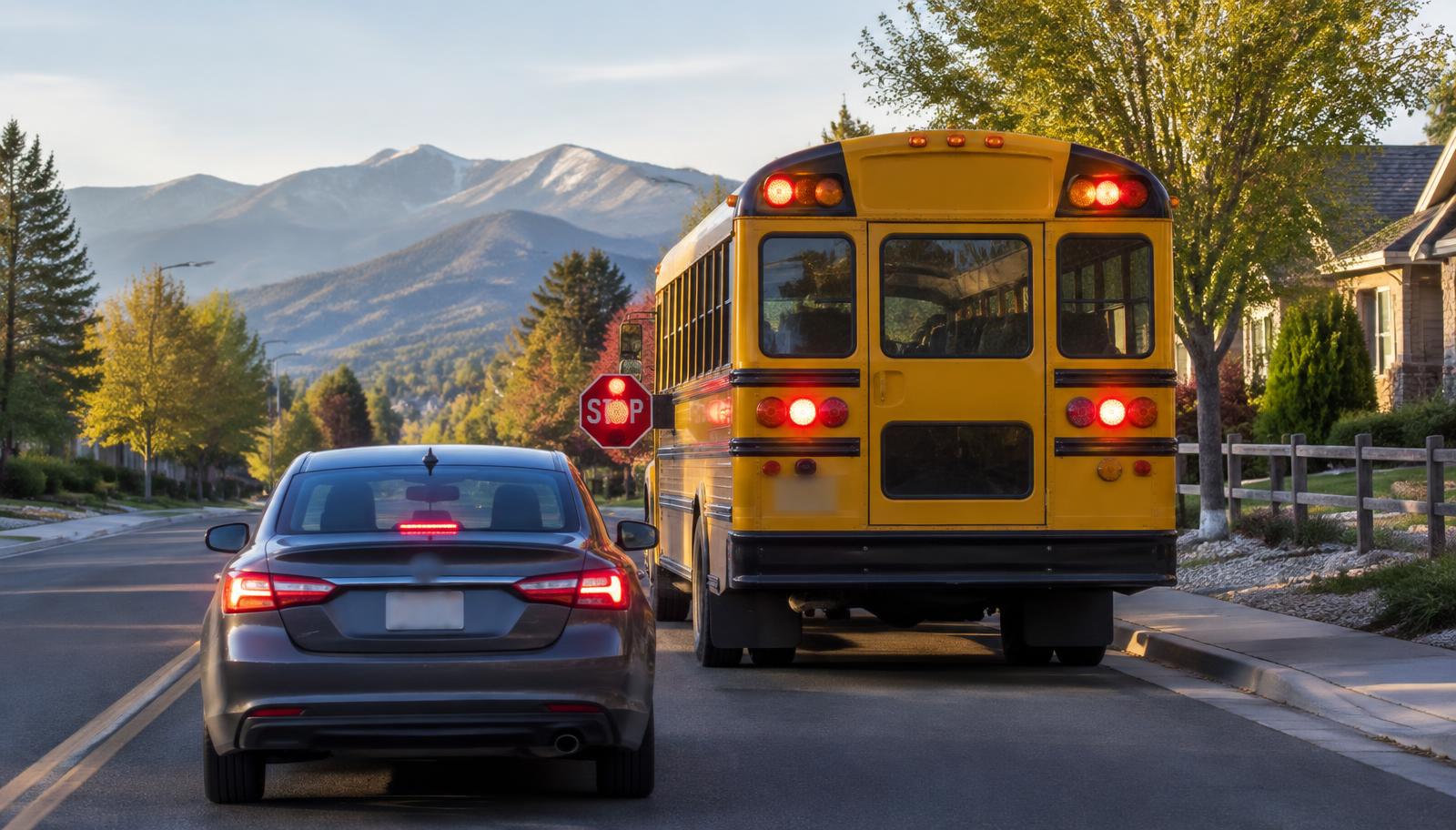
Colorado authorized automated school bus stop-arm camera enforcement in 2025. Two things about that sentence matter more than the authorization itself. It is enabling legislation, not a mandate, so no district is required to do anything. And it contains a vendor compensation restriction that changes which business models are legal here, which means the pitch a district gets from a national stop-arm vendor may not be structurable in Colorado at all.
We are describing the statute below, not giving legal advice. Have counsel review your specific contracting structure before signing anything.
What HB25-1230 does
House Bill 25-1230 took effect May 24, 2025. It creates a civil penalty for illegally passing a stopped school bus, capped at 300 dollars including surcharges and fees, and it authorizes automated enforcement systems to document the violation.
Who may install and operate a system: the state, counties, cities and counties, school districts and municipalities. A school district may operate a program only with school board approval, which means this is a public board decision and not a transportation department purchase.
A district operating a program independently must enter a memorandum of understanding with a law enforcement agency covering cost sharing and enforcement responsibilities. Write that MOU early. It is the item most likely to stall a program after the board has already said yes.
The evidence requirement is a technical requirement
Photographs must capture the vehicle and its license plate. That part is obvious. The part that changes your equipment specification is the rebuttable presumption: it arises when photographs show an electronic indicator that the visual signal lights were activated.
Read that literally. The system has to integrate with the bus warning light circuit and log its state as data, then present that state in the evidence package. A camera that merely records video of a flashing light is weaker evidence and may not create the presumption at all. When you evaluate systems, ask specifically how the light state is sampled, where it is stored, and how it appears in the citation packet. Ask to see a real evidence packet, not a slide about one.
Notices go to the registered owner of the vehicle, which is worth explaining to your community before the first mailing rather than after.
The vendor compensation restriction, and why it matters
This is the reason to read the statute rather than a vendor summary of it. Colorado provides that fines cannot be used to pay manufacturers or vendors, that vendor compensation must be based on the value of equipment or services provided rather than exclusively on the number of citations or the revenue generated, and that contracts cannot contain quotas for violations or revenue.
In practice, that constrains the model that dominates this market nationally: a vendor installs equipment at no upfront cost, operates the program, and is paid out of the fines that violators generate. Districts like it because it looks free. Colorado's language cuts directly across it.
A district that buys equipment and service at a fixed, transparent price is on firmer ground. You know what the system costs, the cost does not move with citation volume, and nobody in the chain has a financial interest in more violations. That is also a better answer at a board meeting when a parent asks whether this program exists to protect children or to generate revenue.
We are not the ones to tell you your contract is compliant. Your counsel is. Bring them the compensation structure, the quota language and the payment source before signature, not after.
Colorado chose permissive on purpose
An earlier bill that would have required automated vehicle identification on every route bus by 2028 was postponed indefinitely. What passed instead lets districts adopt enforcement voluntarily. So if you are being told Colorado districts must equip their fleets, that is not the law. Adoption is a local decision, and a district that decides the program is not worth the administrative load is fully within the statute.
How the rest of our footprint compares
- Colorado: authorized in 2025 under HB25-1230. Penalty capped at 300 dollars. Vendor compensation restricted. School board approval and a law enforcement MOU required for district-run programs.
- Wyoming: authorized, with owner liability of 195 dollars where the driver cannot be determined.
- Utah: authorized since 2017, with mandatory minimum fines of 1,000, 2,000 and 3,000 dollars for first, second and third offenses within five years, plus community service hours. Where camera evidence is used, 20 percent of collected fines goes to the district operating the bus.
- New Mexico: has not authorized automated stop-arm enforcement.
The spread is wide. Utah's structure creates a genuine funding mechanism for the district operating the bus. Colorado's does not, by design. A New Mexico district can still record stop-arm violations for referral to law enforcement, but there is no automated citation pathway.
About the national violation number
You will see roughly 38 to 40 million illegal passings per year quoted as if it were a measured count. It is not. Those figures are projections extrapolated from a single-day national survey of participating bus drivers, scaled across the school year. The projection may well be directionally right, and it is the best data the industry has. It is still an estimate built on one day of observation, and we would rather say that plainly than dress it up.
If you want a number for your own board, count your own. A short observation period on your highest-risk routes produces local evidence that is far more persuasive than a national extrapolation, and the counting itself often reveals which three stops actually need attention.
Where to go next
For the equipment and evidence workflow, see our school bus stop-arm enforcement page. For the wider onboard picture, start at school bus security. For Colorado-specific compliance and market context, see our Colorado service area page. If you want help preparing the technical portion of a board packet, call 303 596 7819.
Frequently asked questions
- Does Colorado require stop-arm cameras on school buses?
- No. HB25-1230 is enabling legislation. Districts and municipalities may operate automated enforcement programs, and a school district needs school board approval to do so.
- How much is the fine in Colorado?
- The civil penalty is capped at 300 dollars including surcharges and fees.
- Can a vendor run the program for free and keep a share of the fines?
- Colorado restricts that structure. Fines cannot be used to pay manufacturers or vendors, compensation must reflect the value of equipment and services rather than citation counts or revenue, and contracts cannot include violation or revenue quotas.
- Do all four states in our footprint allow automated stop-arm enforcement?
- Colorado, Wyoming and Utah authorize it. New Mexico has not authorized automated stop-arm enforcement.